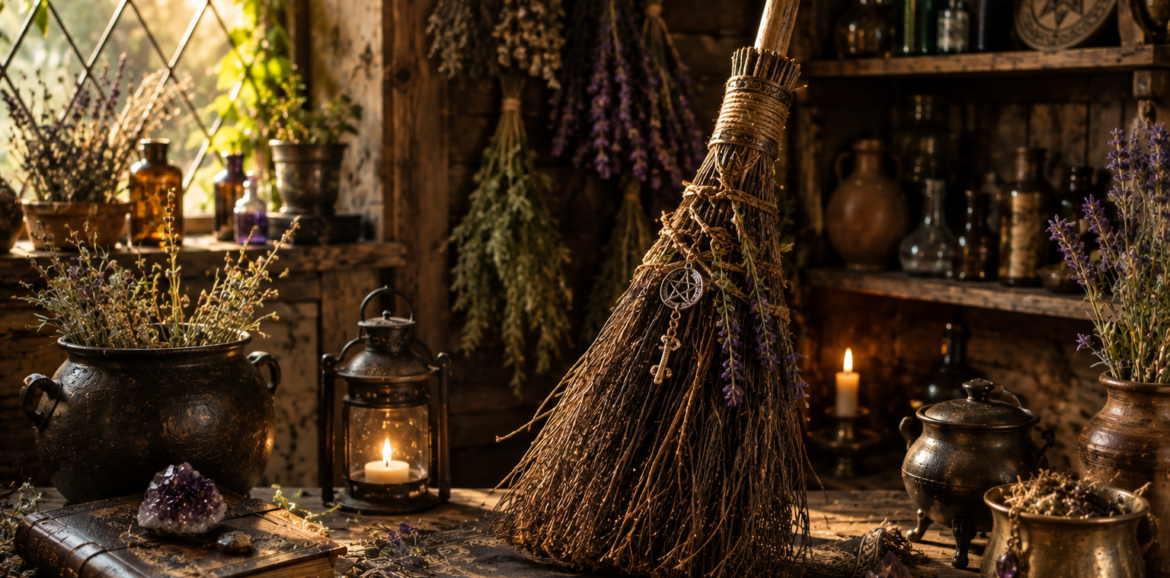
Few objects are more instantly associated with witches than the humble broom.
Thank you for reading this post, don't forget to subscribe!For centuries, popular stories and paintings have depicted witches travelling through the night on broomsticks.
But behind that familiar image is a much more ordinary object with a surprisingly interesting history.
The traditional broom, sometimes known as a besom, was a household tool long before it became one of the most recognisable symbols of witchcraft.
What is a besom?
A besom is a traditional broom made by fastening a bundle of twigs, bristles or other natural material to a handle.
Unlike the modern flat-headed broom familiar in many homes today, traditional besoms could look quite rustic.
They were practical objects used for sweeping floors, hearths and outdoor areas.
Because they were common household possessions, they naturally became part of folklore.
From household tool to magical symbol
The transformation of the broom into a symbol of witchcraft is fascinating.
The broom was associated with the home, domestic work and the hearth.
Yet folklore gradually surrounded it with stories of magic, witches and supernatural activity.
The image of the witch with a broom became particularly powerful because it combined an ordinary household object with an extraordinary idea.
Something familiar had been transformed into something mysterious.
Why a broom?
There may be several reasons why the broom became associated with witchcraft.
It was a tool used in domestic spaces, where much traditional folk magic was also practised.
It was made from natural materials such as wood, twigs and plant fibres.
And it was strongly associated with movement and sweeping away.
Symbolically, sweeping can suggest removing unwanted things and creating a clean beginning.
That symbolism fits naturally with many traditions involving cleansing and renewal.
The famous flying broomstick
The idea of witches flying on broomsticks is one of the most enduring images in European folklore.
Historical accounts and later stories sometimes describe alleged witches using broomsticks or other household objects in connection with magical practices.
Over time, these stories became increasingly elaborate.
Eventually, the flying broom became almost inseparable from the popular image of the witch.
But the familiar picture of a witch soaring across a moonlit sky is largely a product of folklore, storytelling, art and later popular culture.
The broom at the heart of the home
There is another reason the broom is such an interesting magical symbol.
In earlier households, the broom belonged to everyday life.
It was not an exotic ceremonial object.
It was something that might stand beside a fireplace or doorway.
That makes its transformation particularly striking.
An ordinary domestic tool became a symbol of a hidden magical world.
This is something that happens repeatedly in folklore: familiar objects acquire meanings that go far beyond their practical purpose.
Sweeping away the old
The symbolism of sweeping has also survived into modern traditions.
To sweep a room is literally to remove dust and unwanted material.
Symbolically, the same action can represent clearing away the past, unwanted influences or stagnant circumstances.
This does not mean that every historical broom was considered magical.
Rather, it shows why the object has such obvious symbolic potential.
The physical action already carries a powerful metaphor.
Besoms in modern witchcraft
Today, besoms can be found in modern witchcraft and pagan traditions as symbolic or practical objects.
Some people use them as decorative pieces.
Others associate them with cleansing, protection, transitions or household ritual.
The meanings vary considerably between different practitioners.
Modern witchcraft should not automatically be presented as identical to historical folk traditions.
Many contemporary practices have developed through a mixture of older folklore, modern interpretation and personal spirituality.
The broom as a symbol of transformation
Perhaps the most fascinating thing about the witch’s broom is the journey it has taken.
It began as a practical household implement.
It became part of folklore.
It developed an association with witchcraft.
It entered paintings, stories, theatre and popular entertainment.
And eventually it became one of the first objects many people imagine when they hear the word “witch”.
Very few household objects have travelled quite such an extraordinary cultural journey.
More than a broom
The next time you see an old-fashioned besom, it is worth remembering that you are looking at more than a simple cleaning tool.
It represents a meeting point between ordinary domestic life and centuries of folklore.
Its history reminds us that magic in traditional culture was not always imagined in grand castles or mysterious temples.
Sometimes, it was attached to the most ordinary objects in the home.
And perhaps that is why the broom remains such an enduring symbol of witchcraft.
It began in the hearth and household — and folklore gave it wings.