The Mysterious Art That Helped Shape Modern Chemistry
Thank you for reading this post, don't forget to subscribe!For centuries, people searched for ways to transform matter.
Could ordinary metals be changed into gold?
Could a mysterious substance provide extraordinary powers?
Could the secrets of nature be discovered through experiments involving fire, minerals, metals and mysterious compounds?
These questions belonged to the fascinating world of alchemy.
Often portrayed as the strange predecessor of modern chemistry, alchemy was far more complicated than the familiar image of a medieval magician stirring a bubbling cauldron.
It was a mixture of philosophy, experimentation, symbolism and early scientific investigation.
What was alchemy?
Alchemy was a broad collection of traditions concerned with the transformation and properties of matter.
It developed in different forms across several parts of the ancient and medieval world.
Alchemy was especially influential in the Islamic world and later in Europe, while earlier traditions also existed in places such as Egypt, Greece, China and India.
The ideas and methods were not identical everywhere.
Alchemy was therefore not one single system.
It was a collection of evolving traditions connected by an interest in transformation.
The dream of turning metal into gold
Perhaps the most famous goal of European alchemy was transmutation.
Alchemists investigated whether one metal could be transformed into another.
Gold was particularly important because of its beauty, rarity and resistance to corrosion.
The idea that base metals might somehow be purified and transformed into gold became one of the great legends of alchemy.
This led to the search for a legendary substance often called the philosopher’s stone.
The philosopher’s stone
The philosopher’s stone was imagined in different ways by different writers.
Some described it as a substance capable of transforming metals.
Others associated it with purification, perfection or extraordinary knowledge.
Later stories also connected it with the possibility of extending human life.
This is where alchemy becomes especially interesting.
It was not simply about making gold.
It was also concerned with the idea of transformation itself.
Alchemy and the search for perfection
Alchemy often used the language of purification and transformation.
An impure substance could be refined.
A crude material could become something more perfect.
These ideas were sometimes applied symbolically as well as physically.
In some traditions, the transformation of metals could be understood as a metaphor for the transformation of the human being.
This blending of physical experimentation and philosophical thought makes alchemy very different from modern chemistry.
Did alchemists really experiment?
Yes.
Although many alchemical theories were incorrect by modern scientific standards, alchemists carried out practical experiments.
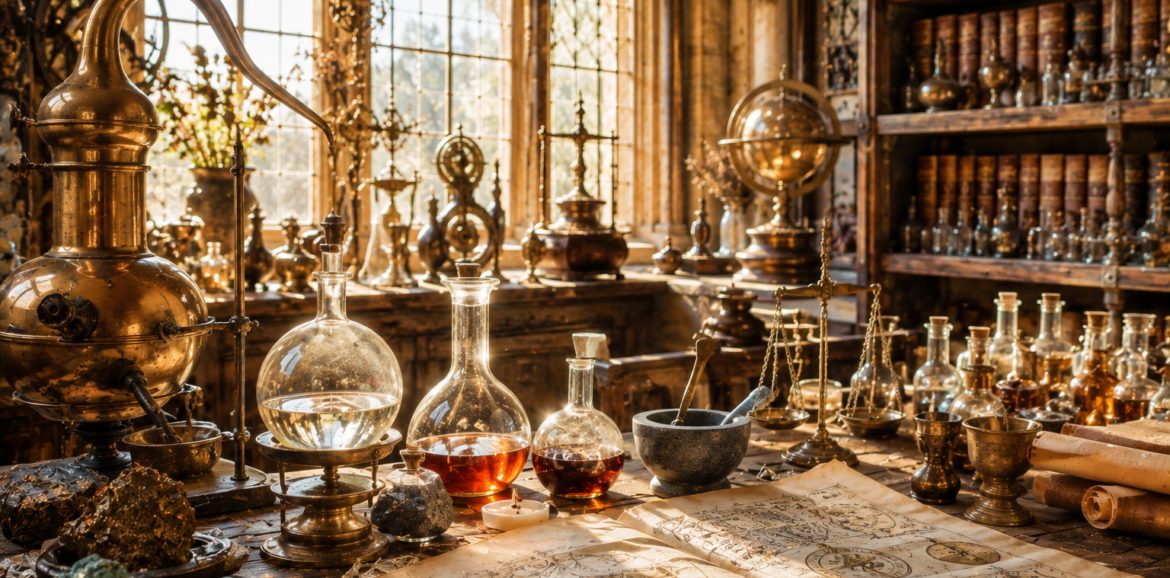
They heated substances, dissolved materials, distilled liquids, observed reactions and developed equipment for laboratory work.
Over centuries, this accumulated practical knowledge contributed to the development of techniques later used by chemists.
Alchemy therefore occupies an unusual position in history.
Its theories may seem mysterious today, but some of its experimental practices were highly practical.
Alchemy and early laboratories
The alchemical laboratory could contain furnaces, vessels, retorts, crucibles and other specialised equipment.
Working with heat and chemicals required considerable skill.
Alchemists recorded observations, copied earlier manuscripts and developed their own procedures.
Some experiments were repeated many times.
Although they did not possess modern knowledge of atoms and chemical elements, their work helped create a tradition of systematic experimentation.
The connection with medicine
Alchemy also became connected with medicine and the preparation of substances intended for human use.
Some historical practitioners believed that carefully prepared substances could influence health or longevity.
These beliefs were not equivalent to modern medicine, and many alchemical remedies would not meet modern scientific standards.
Nevertheless, the search for purified substances encouraged experimentation with minerals, metals, plants and other materials.
From mystery to chemistry
Over time, the study of matter became increasingly systematic.
New ideas about elements, compounds and chemical reactions gradually replaced many older alchemical explanations.
Chemistry emerged as a distinct scientific discipline.
Yet the transition was not simply a case of one subject suddenly replacing another.
Some techniques, laboratory equipment and practical knowledge developed through centuries of alchemical experimentation continued into early chemistry.
Was alchemy a failure?
It would be unfair to describe it simply as a failure.
Alchemists did not discover a reliable method for turning ordinary metals into gold.
Nor did they produce the mythical philosopher’s stone.
But history is rarely that simple.
Their experiments contributed to knowledge about materials, laboratory techniques and chemical processes.
Their work also encouraged generations of investigators to ask questions about the nature of matter.
The mystery that remains
Alchemy continues to fascinate people because it sits between worlds.
It contains elements that seem scientific, philosophical, religious and magical all at once.
Its manuscripts are filled with strange symbols, coded language and mysterious illustrations.
Some texts were deliberately obscure, while others assumed that readers already understood specialised terminology.
This gives alchemical literature an atmosphere of secrecy that continues to capture the imagination.
Alchemy’s remarkable legacy
Modern chemistry is based on scientific principles that differ enormously from those of traditional alchemy.
Yet the historical connection remains fascinating.
Alchemy represents an important stage in humanity’s long attempt to understand what the physical world is made of and how materials can be changed.
The dream of turning lead into gold may have remained unrealised.
But the centuries spent pursuing that dream helped encourage experimentation, observation and curiosity.
Perhaps that is the most unexpected legacy of alchemy.
The search for something mysterious helped lead humanity towards a more systematic understanding of the material world.
And behind the legends of secret laboratories and magical transformations lies a very human story:
The desire to understand what everything is made of — and whether nature’s deepest secrets can be discovered.