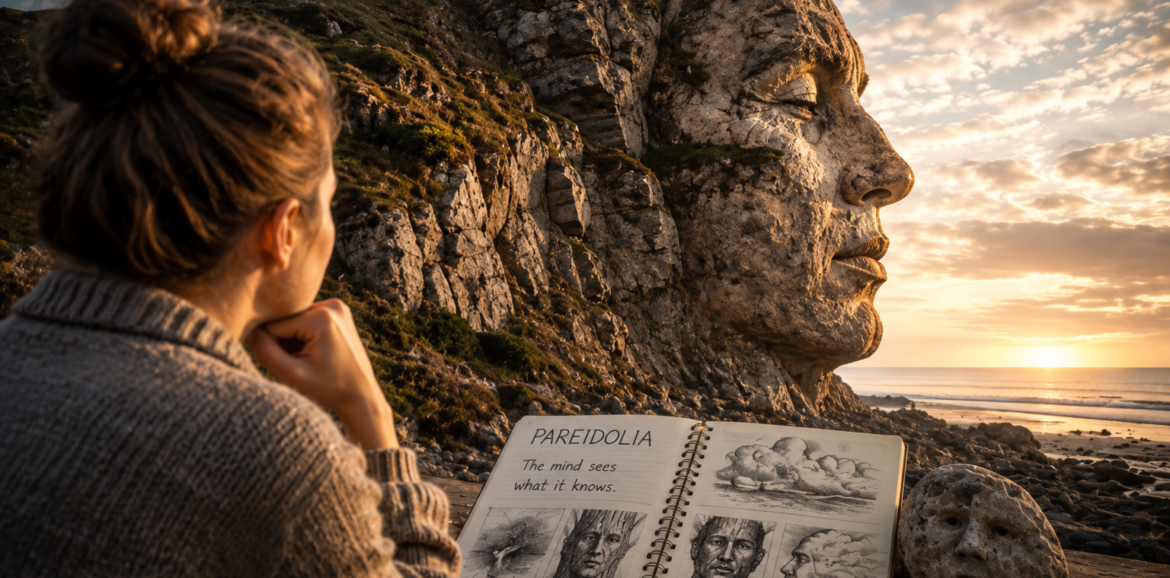
Why We See Faces and Patterns Where None Were Intended
Have you ever looked at a cloud and suddenly noticed a face?
Thank you for reading this post, don't forget to subscribe!Perhaps you have seen what appears to be a figure in the shadows, a face in the pattern of wallpaper or an animal shape in an otherwise ordinary collection of objects.
The image can seem surprisingly clear.
Then you look again and realise that there is nothing actually there.
This fascinating experience is known as pareidolia.
It is one of the reasons the human mind can find familiar shapes and meanings in things that were never designed to contain them.
What is pareidolia?
Pareidolia is the tendency to perceive a recognisable image, pattern or meaning in an ambiguous or random stimulus.
Faces are perhaps the most familiar example.
The human brain is exceptionally good at detecting faces. We can recognise one remarkably quickly, sometimes from only a few simple features.
This ability is useful in everyday life, but it can also lead us to perceive faces where no face exists.
A pattern in a tree might suddenly look like an old man’s face.
A mark on a wall might resemble an eye.
A shadow might appear to have a human form.
The experience can feel completely convincing even though we know intellectually that the object is simply a tree, wall or shadow.
Why are faces so powerful?
Human beings are social animals.
Recognising other people is enormously important, particularly recognising expressions and emotional states.
Because of this, our brains appear highly sensitive to anything that might resemble a face.
It is generally better from a survival point of view to occasionally mistake a harmless shape for a possible face than to overlook a genuine person watching us.
That sensitivity can produce some wonderfully strange experiences.
A few marks in the right arrangement may suddenly become eyes, a nose and a mouth.
Once we see the face, it can be surprisingly difficult not to see it again.
The face in the toast
Perhaps the most famous modern examples involve food.
People have reported seeing faces in toast, pancakes, pieces of fruit and other everyday objects.
Such discoveries can become newsworthy, particularly when the supposed face resembles a famous person or religious figure.
The object itself has not changed.
What has changed is our interpretation of its pattern.
The mind has taken an ambiguous collection of shapes and organised them into something familiar.
Pareidolia is not simply about faces
Faces are the classic example, but pareidolia can involve many different things.
People may see:
- animals in clouds
- figures in rock formations
- familiar objects in shadows
- letters or symbols in random patterns
- landscapes in stains or textures
- meaningful shapes in natural formations
Our minds are constantly attempting to organise the information reaching our senses.
Sometimes that organisation produces an unexpectedly imaginative result.
Why does it feel so real?
Knowing that an image is imaginary does not necessarily make the experience disappear.
If you see what looks like a face in a tree, you may still experience an immediate impression of a face before consciously deciding that it is simply bark and shadow.
This is because perception is not merely a camera recording the world.
The brain interprets information.
It makes rapid predictions about what we are looking at and compares incoming information with patterns that we already know.
That process normally helps us understand the world efficiently.
Occasionally, however, it produces a fascinating false match.
Pareidolia and unusual experiences
This is where pareidolia becomes particularly interesting from a cultural and spiritual perspective.
Throughout history, people have interpreted unusual shapes and patterns in many different ways.
A strange shape in a tree, a face-like mark in stone or an unexpected figure in a shadow might once have been regarded as an omen, a message or a supernatural sign.
Modern science offers a psychological explanation for many such experiences.
But understanding the mechanism does not necessarily make the experience uninteresting.
In fact, it may make it more fascinating.
It shows us how perception, expectation, memory and imagination interact.
Does seeing a face mean something is wrong?
No.
Ordinary pareidolia is a common human experience.
Seeing a face in a cloud or an animal in a rock formation does not, by itself, indicate that anything is wrong.
It is simply an example of the brain finding structure in ambiguous information.
Indeed, artists and designers have long been fascinated by the same tendency.
A few carefully positioned lines can be enough to make us perceive an expression or personality.
The difference between perception and interpretation
One of the most interesting lessons of pareidolia is the difference between seeing something and deciding what it means.
You might genuinely see a face-like pattern.
The perception itself is real.
But that does not automatically mean that the object contains a face or that the appearance carries a hidden message.
This distinction is useful whenever we encounter unusual experiences.
Our senses provide information, while our minds interpret that information.
The interpretation can be fascinating without necessarily being literally true.
Why pareidolia matters
Pareidolia gives us a small window into one of the most extraordinary things about being human.
We do not experience the world as a collection of meaningless pixels, sounds and sensations.
Our brains continually search for relationships, patterns and familiar forms.
That ability helps us recognise friends, read words, navigate our surroundings and understand complicated situations.
The same ability can also make a cloud look like a dragon.
It can make a shadow look like a person.
It can turn a random collection of marks into a face.
Perhaps that is part of the enduring fascination of pareidolia.
The strange face in the clouds is not necessarily a supernatural mystery.
It may be something equally remarkable:
the human mind revealing how extraordinarily good it is at finding meaning in the world around us.