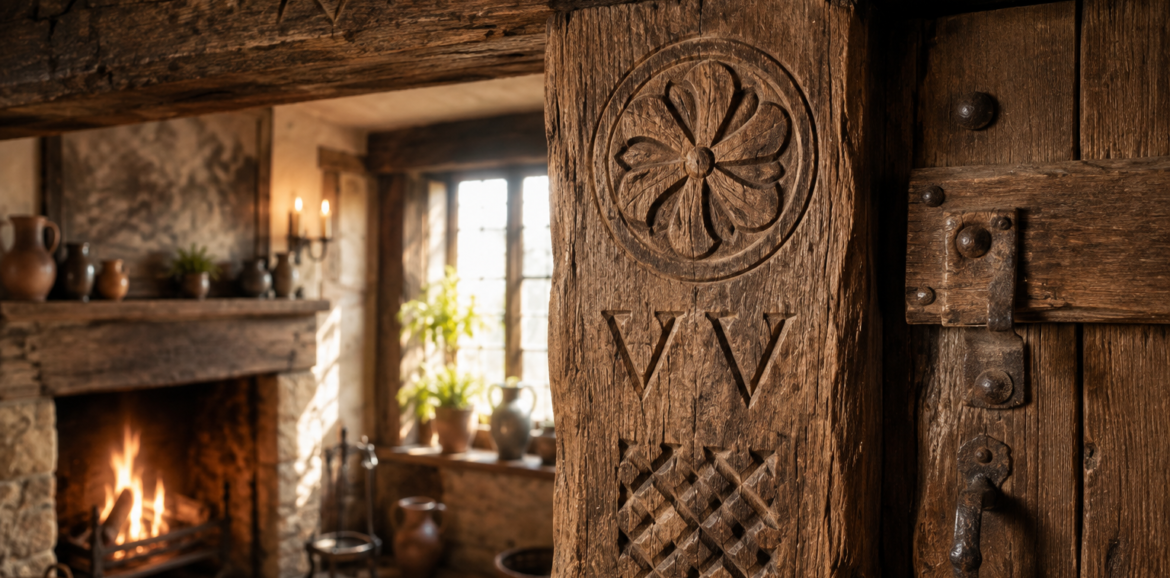
Walk into an old farmhouse, cottage or medieval building in Britain and you may notice something unusual carved into a beam, scratched into a doorway or cut into stone.
Thank you for reading this post, don't forget to subscribe!At first glance, it might look like an ordinary mark made by a builder, carpenter or previous occupant.
But some of these strange symbols have another story.
They are known as witch marks, although the name can be misleading. Many were not associated with witches in the sense suggested by modern popular culture. Instead, they were often intended as protective marks, created by people who believed that particular symbols could help guard a home against evil, misfortune or unwanted supernatural forces.
These mysterious markings provide a fascinating glimpse into the beliefs of earlier generations.
What were witch marks?
Witch marks are symbols or patterns deliberately made on buildings, usually in places where people believed protection was particularly important.
They can be found around doors, windows, fireplaces, staircases and other points of entry or transition.
Some consist of simple geometric patterns. Others are made from interlocking lines, circles or repeated shapes.
One particularly famous design is the hexafoil, sometimes called a daisy wheel. It is formed from overlapping circles and can resemble a six-petalled flower.
Other marks include the Marian symbol, known as a VV, believed to represent the Virgin of Virgins, and various forms of crossed or interwoven lines.
Why were they made?
To understand witch marks, it is important to remember that people in earlier centuries often viewed the world differently from us.
Religion, folklore, superstition and everyday life were closely connected.
A doorway was not merely an entrance into a building. It was also a boundary between the protected interior of a home and the outside world.
Windows and fireplaces could similarly be regarded as vulnerable points.
Marking these places with protective symbols may therefore have been intended to create an additional spiritual barrier.
The people who made such marks did not necessarily think of themselves as practising witches.
They may simply have believed they were protecting their homes.
The protective power of repetition
One fascinating feature of many historical protective marks is repetition.
A symbol might be carved over and over again.
This could have practical explanations. A carpenter or mason might have used a familiar design because it was traditional.
But repetition also has a powerful symbolic quality.
Writing or drawing the same protective pattern repeatedly may have been considered a way of reinforcing its purpose.
The physical act of carving the mark could itself have been meaningful.
Marks around fireplaces
Fireplaces are among the most intriguing places to find protective markings.
In an old house, the fireplace was an important centre of domestic life. It provided warmth and was associated with cooking, light and the continuation of the household.
But chimneys also created an opening through which something unwanted might theoretically enter.
It is therefore unsurprising that protective marks are sometimes found around fireplaces and chimney openings.
Some historical buildings contain remarkably elaborate examples.
Witch marks and the fear of witchcraft
The term “witch mark” can give the impression that these symbols were made by witches.
That is not necessarily true.
In many cases, the marks appear to have been intended to protect people from witchcraft rather than practise it.
This distinction is important.
A household might have used a protective symbol because its occupants feared curses, supernatural interference or bad fortune.
The mark therefore tells us something about what people believed could threaten them.
In that sense, these markings are valuable historical evidence.
Hidden symbols rather than decorations
Another intriguing feature is that many protective marks were not intended to be decorative.
Some are extremely difficult to notice.
A mark might be placed inside a doorway, beneath a beam or in an area that would rarely attract attention.
That raises an interesting question.
If nobody was supposed to admire the symbol, who was it for?
Perhaps the person who made it believed that its effectiveness did not depend upon being seen.
The hidden nature of some marks may therefore have been part of their significance.
What can witch marks tell us today?
These symbols offer more than an opportunity to admire unusual old carvings.
They remind us that previous generations had their own explanations for uncertainty, danger and misfortune.
Before modern scientific explanations became widespread, people developed traditions to make sense of events they could not control.
Protective symbols gave people a way of expressing hope and creating a feeling of security.
The practice also demonstrates how folklore could become physically embedded in the buildings where people lived.
Are all unusual marks witch marks?
No.
This is an important caution.
Old buildings contain countless scratches, carpenter’s marks, initials, construction marks and accidental damage.
Not every unusual symbol has a supernatural meaning.
Even when a marking resembles a recognised protective symbol, its exact purpose may not always be known.
Historical interpretation requires care.
That uncertainty, however, arguably makes these markings even more fascinating.
A hidden magical history
The next time you enter an ancient British building, look carefully at the doorways, beams and fireplaces.
You may find evidence of beliefs that have survived quietly in the fabric of the building for centuries.
A simple circle scratched into timber can raise questions about the people who lived there, what they feared, what they believed and what they hoped to protect.
That is perhaps the greatest fascination of witch marks.
They are small pieces of physical evidence from a world in which the boundary between religion, folklore, magic and everyday life was often much less clearly defined than it is today.
And sometimes, the most intriguing stories in an old house are the ones hidden in its walls.