The Extraordinary History of Physical Mediumship
Encyclopedia Section
Of all the strange phenomena associated with the golden age of Spiritualism, few are more extraordinary than ectoplasm.
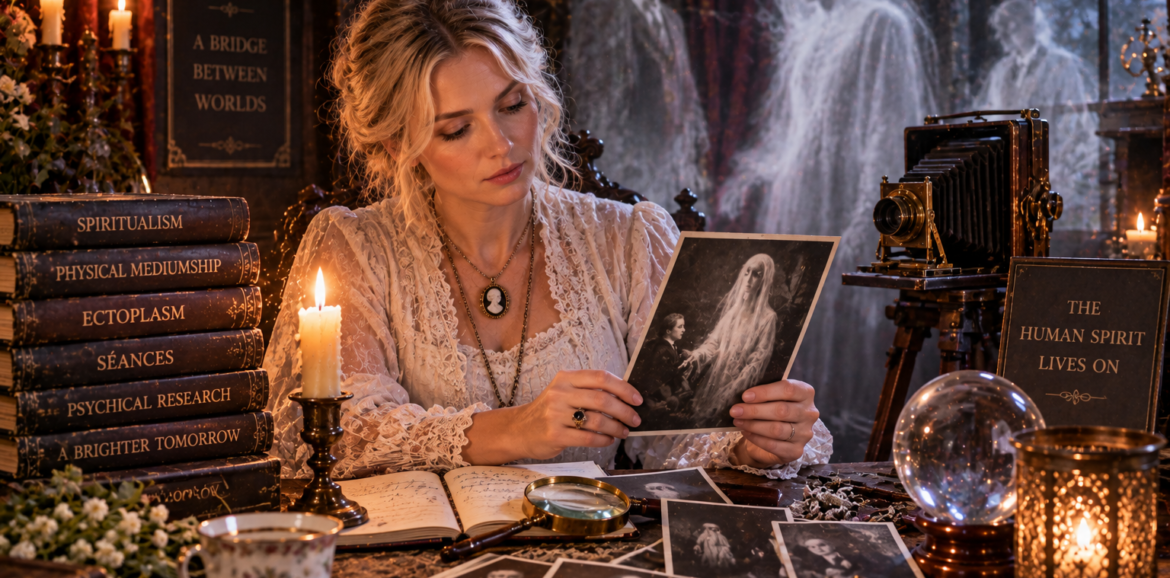
Thank you for reading this post, don't forget to subscribe!Old photographs sometimes appear to show pale material emerging from a medium during a séance.
To believers at the time, this could be interpreted as evidence of spirit manifestation.
To investigators and sceptics, many such demonstrations raised very different questions.
So what exactly was ectoplasm supposed to be?
Ectoplasm and the Séance Room
During the late nineteenth and early twentieth centuries, Spiritualism attracted enormous public interest.
Mediums claimed many different abilities.
Some offered messages said to come from people who had died.
Others became associated with what was called physical mediumship — alleged phenomena that appeared to affect the physical environment.
Reports included mysterious knocks, moving objects, levitation and materialisations.
Ectoplasm became one of the strangest claims of all.
What Was Ectoplasm Supposed to Look Like?
Descriptions varied considerably.
It was sometimes described as a pale, misty or fabric-like substance apparently emerging from the medium’s mouth, nose or body.
In some accounts, the substance was said to form shapes.
Faces, hands or even human-like figures were sometimes reported.
Photographs of alleged ectoplasmic manifestations became famous and remain among the most peculiar images associated with historical Spiritualism.
Where Did the Word Come From?
The term ectoplasm became associated with psychical research around the turn of the twentieth century.
It was used to describe the supposed substance involved in physical manifestations during mediumistic séances.
The word later escaped from the séance room and entered popular culture.
Today, many people know “ectoplasm” from supernatural films, television programmes and ghost stories without necessarily knowing about its connection with historical mediumship.
Why Were Séances Often Held in Darkness?
Many physical-mediumship séances took place in dimly illuminated rooms.
Believers sometimes maintained that bright light interfered with physical manifestations.
Critics immediately recognised a difficulty: darkness also made deception much easier.
Investigators therefore attempted various forms of control, although standards differed greatly and were not comparable with modern experimental procedures.
This tension between belief and investigation became a recurring feature of psychical research.
Fraud and Controversy
The history of physical mediumship includes documented examples of deception.
Investigators sometimes discovered materials that could imitate supposed supernatural manifestations.
This does not tell us what happened at every séance, and people who believe in mediumship may distinguish fraudulent demonstrations from experiences they consider genuine.
Historically, however, the exposure of fraud is an essential part of the ectoplasm story and shouldn’t be ignored.
Why Did Intelligent People Take It Seriously?
It can be tempting to look at an old ectoplasm photograph and wonder how anybody could have believed it.
But that ignores the historical setting.
People living through the nineteenth and early twentieth centuries were witnessing astonishing technological and scientific developments.
Photography could capture an image.
Telegraphy could transmit messages across enormous distances.
X-rays revealed things hidden inside the human body.
Wireless communication allowed information to travel invisibly through the air.
Against that background, the possibility of another undiscovered force did not necessarily sound as extraordinary as it may today.
Ectoplasm and Psychical Research
Researchers interested in paranormal claims attempted to determine whether physical-mediumship phenomena represented evidence of something unknown.
The subject attracted believers, scientists, magicians, sceptics and investigators.
Some were impressed by particular mediums.
Others exposed trickery.
The resulting arguments became part of the wider history of attempts to investigate psychic and spiritual phenomena scientifically.
Is Ectoplasm the Same as a Ghost?
Not exactly.
In historical Spiritualist terminology, ectoplasm was supposed to be a substance through which a manifestation might occur.
A ghost, apparition or spirit was a different concept.
Popular culture has blurred these distinctions considerably.
That is why looking at the original history can be so fascinating.
From Séance Rooms to Cinema
Ectoplasm eventually became part of the visual language of supernatural entertainment.
Writers and filmmakers could hardly resist it.
The idea of an invisible spirit producing a visible mysterious substance was perfect material for ghost stories.
As a result, a term once discussed seriously by psychical researchers became familiar to millions of people who had never attended a séance.
A Fascinating Chapter in Spiritual History
Whether viewed through the history of Spiritualism, psychology, sceptical investigation or paranormal belief, ectoplasm occupies an extraordinary place in our cultural imagination.
It reminds us of a period when people gathered in darkened rooms hoping for physical evidence that death might not be the end.
Some encountered deception.
Some remained convinced that they had witnessed something inexplicable.
And more than a century later, the strange photographs survive.
They show us not merely what people claimed to see, but something equally fascinating:
how strongly human beings have always wanted to know whether there is another world beyond the one we can see.