History, Belief and the Mystery of Spirit Communication
Few objects associated with the supernatural are as instantly recognisable as the Ouija board.
Thank you for reading this post, don't forget to subscribe!For some people, it is a fascinating piece of social and cultural history.
For others, it represents an attempt to communicate with spirits.
And for some, it remains an unsettling mystery.
But where did the Ouija board actually come from, and why has it remained so famous?
What Is a Ouija Board?
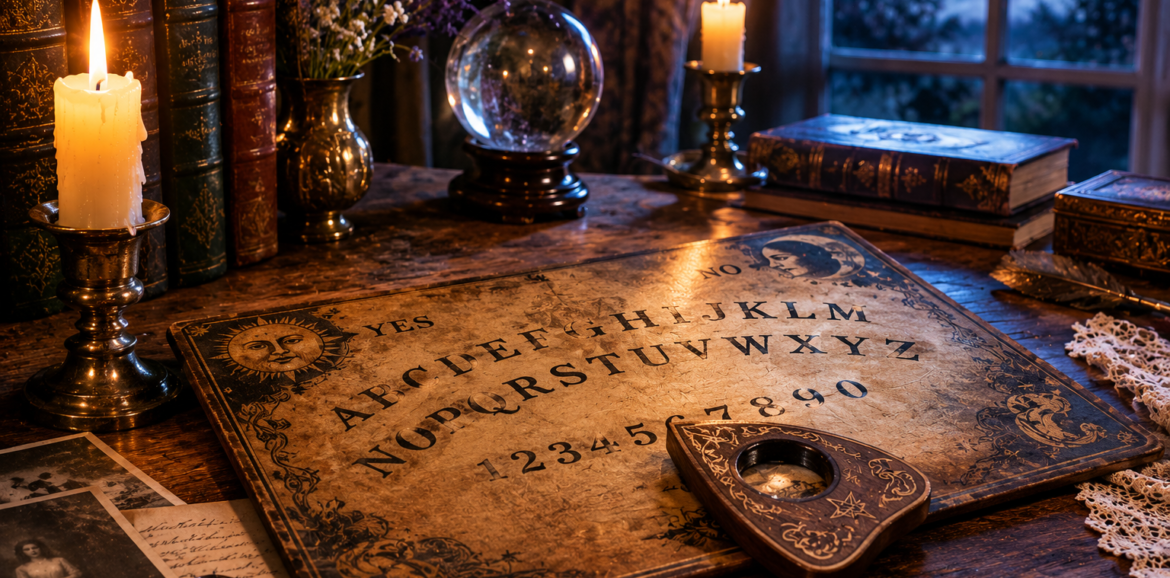
A traditional Ouija board is a flat board containing letters of the alphabet, numbers and words such as “yes” and “no”.
It is normally used with a small movable pointer called a planchette.
Participants place their fingers lightly on the planchette and ask questions.
The planchette may then appear to move across the board, pointing towards letters and forming words.
Believers may interpret the resulting messages as communication with a spirit or another unseen presence.
Other explanations focus on psychological and physical processes.
The Spiritualist Movement
The popularity of talking to the dead grew considerably during the nineteenth century.
Spiritualism developed into a major movement, particularly in Britain, the United States and other parts of the Western world.
Séances, mediums and various forms of communication with the spirit world attracted enormous public interest.
People who had lost loved ones sometimes hoped that a medium could provide evidence that consciousness continued after death.
The Ouija board emerged from this wider fascination with communicating with the unseen.
Where Did the Name Come From?
The name “Ouija” has become inseparable from the board itself.
There are several stories surrounding its origin, which have helped add to its mystery.
One commonly repeated story says that the name was obtained by asking the board itself what it wanted to be called.
Whether that story should be regarded as historical fact or part of the mythology surrounding the object is another matter.
Like many subjects connected with the paranormal, the Ouija board has accumulated stories of its own.
How Does the Planchette Move?
This is where the subject becomes particularly interesting.
People who believe in spirit communication may interpret the movement as evidence that an outside intelligence is controlling the planchette.
Psychological research and popular explanations have also drawn attention to the possibility that participants can move it without consciously intending to do so.
This phenomenon is commonly associated with the ideomotor effect.
In simple terms, people can sometimes make small physical movements without being consciously aware that they are doing so.
That does not tell us what every individual experience means, but it provides one possible explanation for why a planchette can appear to move mysteriously.
Why Does the Experience Feel So Convincing?
The experience can be remarkably compelling.
Several people may have their fingers resting on the same planchette.
Nobody may feel that they are deliberately pushing it.
Yet it moves.
When letters begin to form words, the result can seem extraordinary.
The combination of expectation, concentration, subtle movements and the atmosphere surrounding the experience can make the event feel deeply mysterious.
This is one reason the Ouija board has remained such a powerful subject in popular culture.
The Ouija Board and Popular Culture
Books, films and television programmes have frequently portrayed Ouija boards as dangerous objects capable of opening doors to hostile supernatural forces.
These stories have contributed enormously to the board’s reputation.
However, fictional portrayals should not be confused with historical evidence.
The real history of the Ouija board is considerably more complicated and interesting than many horror stories suggest.
It belongs to a much wider history of spiritualism, séance culture and people’s fascination with communication beyond the ordinary senses.
Why Are People Still Fascinated?
The Ouija board touches upon one of humanity’s oldest questions:
Can we communicate with something beyond the physical world?
That question has appeared in many different forms throughout history.
People have consulted mediums, interpreted dreams, studied unusual experiences and developed systems of divination in their attempts to understand what may lie beyond ordinary perception.
The Ouija board is simply one of the more modern and recognisable examples.
Belief and Personal Experience
People have very different opinions about Ouija boards.
Some regard the experience as entirely psychological.
Others believe that genuine spirit communication can occur.
For others, the subject is simply an interesting part of the history of spiritualism.
There is no need to dismiss someone’s personal experience simply because another person interprets it differently.
At the same time, an unusual experience does not automatically prove a supernatural explanation.
Keeping both possibilities in mind is part of what makes the subject so intriguing.
The Mystery Continues
More than a century after the Ouija board became widely known, people are still fascinated by the possibility of communicating with the unseen.
Perhaps that is the real reason the board has endured.
It sits at the meeting point between psychology, folklore, spiritualism, popular culture and the enduring human desire to understand mysteries that have no easy answers.
Whether you see the Ouija board as a historical curiosity, a psychological phenomenon or something more mysterious, its story remains one of the most fascinating chapters in the history of spirit communication.