By David Charles Psychic
Thank you for reading this post, don't forget to subscribe!A few golden stems, carefully folded and woven, can become something remarkably beautiful.
Corn dollies belong to a world where the harvest was more than a date in the farming calendar. It represented food, work and the hope of making it through another winter.
These delicate objects bring craftsmanship and folklore together. Their story asks a question that remains relevant: how do we acknowledge what has sustained us?
More than a little figure
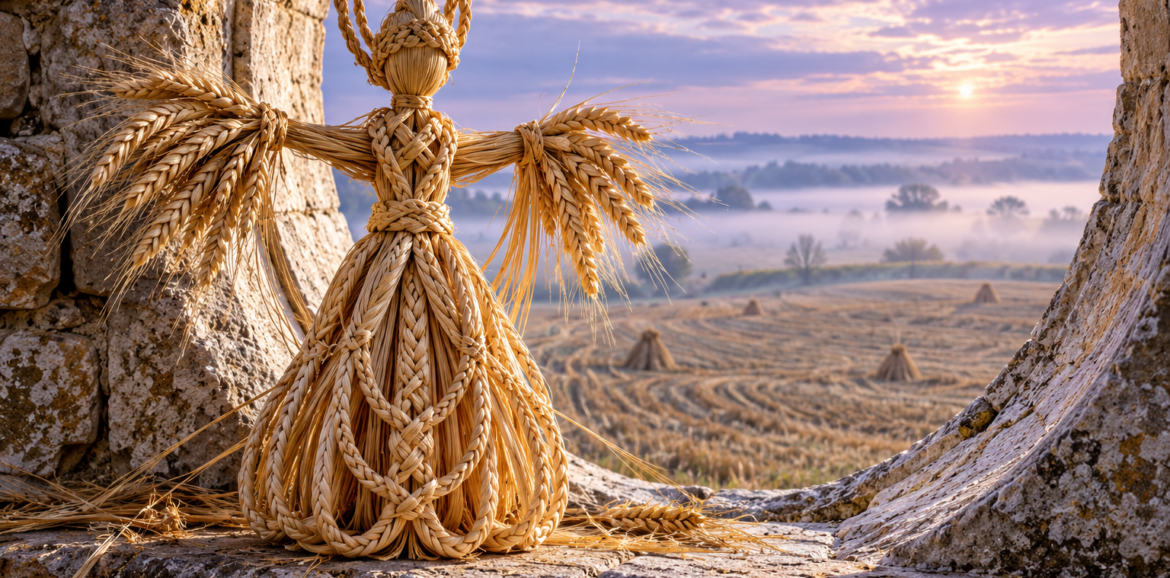
The name “corn dolly” may suggest a small human shape, but straw work can take many forms.
The Museum of Witchcraft and Magic in Boscastle holds examples known as Mother Earth and the Man in Armour. Its collection also includes a design called the Okehampton Mare—a particularly interesting connection for those of us in Devon. Museum of Witchcraft and Magic
An object made from humble material can reveal considerable patience and skill. Curves, plaits and carefully balanced shapes transform stems that might otherwise be overlooked.
Before considering any spiritual interpretation, there is already something to admire: the maker’s hands and the knowledge passed between generations.
The last sheaf and the winter ahead
The Food Museum describes a tradition in which straw from the final sheaf was woven into a dolly, understood in folklore as a winter home for the spirit of the corn. That is a recorded belief, rather than a literal explanation of how crops grow. Food Museum
Its symbolism is easy to understand.
The harvest ends, but life must continue. Something from the completed season is kept and carried forward. The object joins an ending to the possibility of another beginning.
It also gives physical form to gratitude. Instead of simply consuming the harvest, people set aside time and material to mark its importance.
What the tradition can mean now
Many of us live at a distance from the work that produces our food. A harvest object can prompt us to notice that dependence again.
But the idea reaches beyond farming.
We all have seasons of effort: caring for a relative, building a business, studying, maintaining a home or recovering after a difficult period. When one stage ends, we may move immediately to the next without acknowledging what it required.
A woven harvest symbol offers another possibility: pause, recognise the work and consider what deserves to be carried forward.
That might be a useful lesson, a friendship or a habit that helped you through.
A simple moment of gratitude
You do not need to make or buy a corn dolly to explore this meaning.
Choose an ordinary object connected with something you value. Set it beside a notebook and write three sentences:
What has sustained me?
Whose effort am I grateful for?
What will I nurture next?
This is a reflective activity, not a promise of prosperity. Its purpose is to bring attention to things that can disappear beneath everyday worries.
The lasting beauty of the corn dolly is that it makes something precious from what is close at hand. Straw becomes a reminder that effort deserves recognition—and that endings can hold the beginnings of something new.
Discover more of the stories behind traditional objects with David Charles Psychic.