By David Charles Psychic
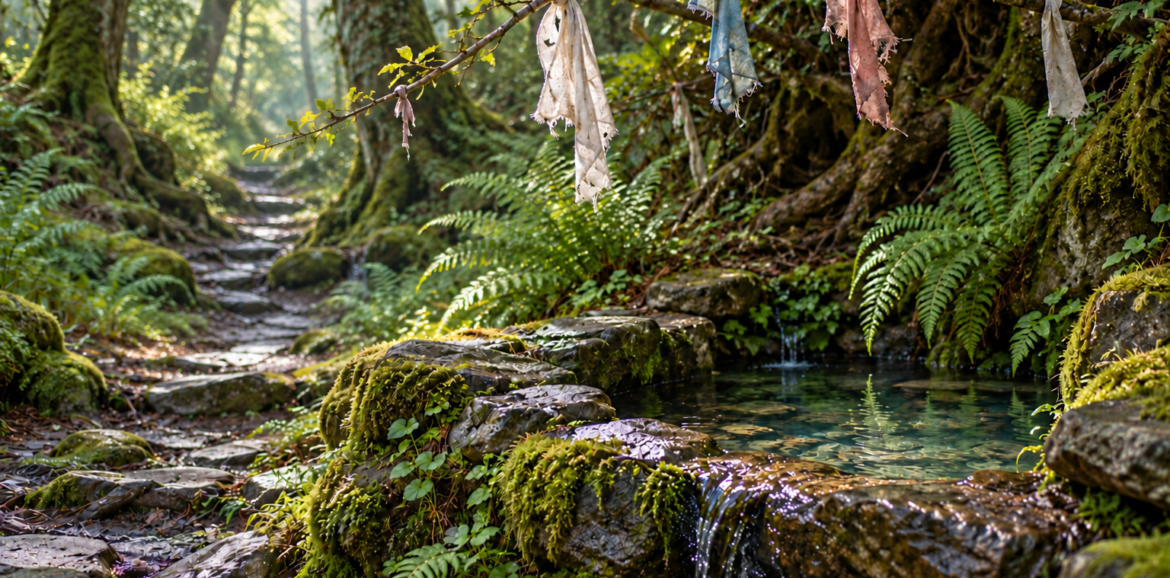
Thank you for reading this post, don't forget to subscribe!Imagine entering a quiet woodland and finding small pieces of cloth tied among the trees.
At first, the sight may seem puzzling. Then you realise that each fragment could represent a personal hope, a remembered worry or a wish made on someone else’s behalf.
This is the distinctive world of the clootie well: a place where landscape and human longing meet.
What is a clootie well?
A “cloot” is a piece of cloth or rag. Forestry and Land Scotland describes the traditional practice of dipping a rag into a well and tying it to a nearby tree. In the associated belief, an illness would fade as the cloth gradually decayed.
Munlochy, on Scotland’s Black Isle, is one recorded example. These are healing traditions within folklore, not evidence that well water or tied cloth can cure illness. FLS
Understanding that distinction allows us to appreciate the custom without making medical claims.
Giving a private feeling a visible form
One striking feature of the tradition is its simplicity.
A person arrives carrying something difficult to express. Through a small action, an inward concern becomes outward and tangible.
There is no need to assume that every visitor had the same belief or expectation. People can approach a place with curiosity, religious faith, family memories or a desire for quiet.
That variety is part of what makes such places meaningful. A woodland can hold many different stories without revealing the details of any one of them.
The symbolism of slow change
The image of cloth gradually weathering offers a useful subject for reflection.
We often want uncertainty to disappear immediately. Yet many ordinary changes happen through time and repeated effort: learning to live with a loss, rebuilding trust or finding the courage to make a decision.
As a modern interpretation, the fading cloth can represent the wish to loosen our hold on a worry. That interpretation is personal symbolism, rather than a claim about what the original custom meant to every participant.
A meaningful gesture may help someone pause and name a feeling. It cannot guarantee that the problem behind that feeling will disappear.
Respecting the place
A tradition associated with nature should also encourage care for it.
If you visit a historic well, follow the site’s current guidance. Leaving nothing behind is a considerate way to experience the setting. You can take a photograph, sit quietly or record your thoughts afterwards.
There is no need to tie anything to a tree to take a place seriously.
At home, a similar reflection can be made with a piece of cloth held briefly in your hands, then put away or reused. Ask yourself: what concern can I name, and what useful step can I take?
The person behind the offering
What stays with me about clootie wells is the human feeling behind them.
Across different times and beliefs, people have looked for a place to put their hopes. The landscape becomes a witness to something that matters deeply to them.
These traditions invite curiosity, but also tenderness. Behind an unfamiliar custom may be a very familiar wish: that tomorrow might feel a little easier than today.
Explore folklore, symbolism and spiritual reflection with David Charles Psychic, serving clients in the UK and internationally.