The Ancient Belief Behind One of the World’s Most Famous Symbols
Few symbols are more recognisable across different cultures than the evil eye.
Thank you for reading this post, don't forget to subscribe!Often represented by an eye-shaped design, the symbol appears in jewellery, artwork, architecture and household objects in many parts of the world.
But what does the evil eye actually mean?
The belief is much older and more widespread than many people realise, and its history reaches across several cultures and centuries.
What is the evil eye?
The evil eye is the belief that a person can cause harm to another person through a malicious or envious look.
The idea is sometimes described as an invisible form of harmful attention.
In traditional belief, the person giving the evil eye may not even deliberately intend to cause harm.
Envy, excessive admiration or jealousy could sometimes be regarded as enough to create danger.
This is one reason protective symbols connected with the evil eye became so widespread.
An ancient belief
Beliefs resembling the evil eye can be traced back thousands of years.
References to harmful or envious looks appear in the ancient Mediterranean and Near Eastern worlds.
The idea subsequently became part of numerous cultural traditions.
Although the details differ from place to place, the underlying fear is remarkably familiar:
Could another person’s envy somehow bring misfortune?
That question has appeared in human culture for a very long time.
The famous blue eye symbol
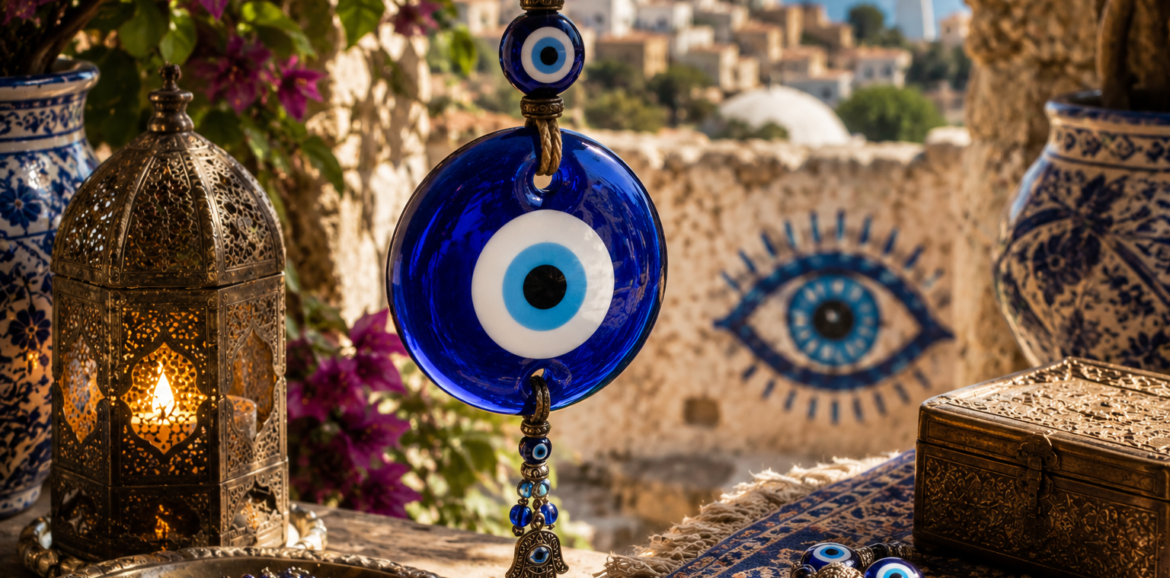
One of the best-known modern representations is the blue-and-white circular eye often associated with Turkey and surrounding regions.
It is commonly called a nazar.
You may have seen it hanging in homes, displayed in shops or worn as jewellery.
The design is strikingly simple: concentric circles create the appearance of a large eye.
Its purpose is traditionally associated with protection from the evil eye.
Today, the symbol is also widely used as a cultural and decorative motif.
Why an eye?
The eye has enormous symbolic power.
It is through our eyes that we observe the world and other people.
A stare can communicate affection, anger, admiration, suspicion or hostility without a single word being spoken.
It is therefore easy to understand why the eye became associated with invisible influence.
The idea of a harmful gaze gives physical form to something that otherwise cannot be seen: another person’s envy or hostility.
Envy and misfortune
One of the most interesting aspects of the evil-eye tradition is its relationship with envy.
Success can attract admiration, but in some traditional cultures it could also attract concern.
A beautiful child, a prosperous household, a successful harvest or a fortunate event might be seen as something that could provoke jealousy.
Protective customs therefore developed around the idea of avoiding or deflecting harmful attention.
The belief reveals something important about human society.
People have always been aware that admiration and envy can exist side by side.
The evil eye across cultures
There is no single version of the evil eye.
Beliefs surrounding it have appeared in different forms throughout the Mediterranean, the Middle East, North Africa, South Asia and elsewhere.
The symbols, rituals and explanations vary considerably.
That diversity is important.
It would be misleading to suggest that every culture sharing an evil-eye belief understood it in exactly the same way.
Instead, the similarities reveal how widespread the human concern about envy and misfortune has been.
Protection and symbolism
Objects associated with protection from the evil eye can be found in many forms.
People have worn them as jewellery, placed them in homes or incorporated eye-like designs into decorative objects.
For believers, these objects could carry spiritual significance.
For others, they may simply be beautiful examples of traditional art.
A symbol can therefore have several meanings at once.
It can be religious to one person, cultural to another and decorative to someone else.
Is the evil eye scientifically proven?
There is no scientific evidence demonstrating that a person’s gaze can transmit a supernatural force that causes misfortune.
The evil eye belongs to the world of traditional belief, folklore and cultural history.
That does not make the subject uninteresting.
Quite the opposite.
Studying beliefs such as the evil eye helps us understand how different societies have tried to explain jealousy, uncertainty, illness, bad fortune and events that seemed difficult to control.
Why has the belief survived?
Perhaps because the emotions behind it are timeless.
People still experience envy.
People still worry about being judged.
People still feel uneasy when something unexpectedly goes wrong.
And people still use symbols to express hope, identity and protection.
The evil eye has survived partly because it gives a visual form to an ancient human concern.
The eye itself has become a symbol that people can immediately recognise.
More than a symbol
The evil eye is not simply a piece of jewellery or a decorative design.
It is the surviving expression of a much older idea about human relationships and the power we believe other people can have over our fortunes.
Whether viewed as folklore, cultural history, religious tradition or symbolism, it offers a fascinating glimpse into the imagination of generations of people.
A small blue eye on a wall or around someone’s neck can therefore carry a remarkably long story.
And perhaps that is why the symbol remains so instantly recognisable today.