The Curious History of a Forgotten Magical Tradition
Thank you for reading this post, don't forget to subscribe!Among the many strange objects associated with the history of witchcraft, few are as intriguing as the witch’s ladder.
Unlike the elaborate ceremonial objects often associated with modern images of witchcraft, a witch’s ladder can be remarkably simple.
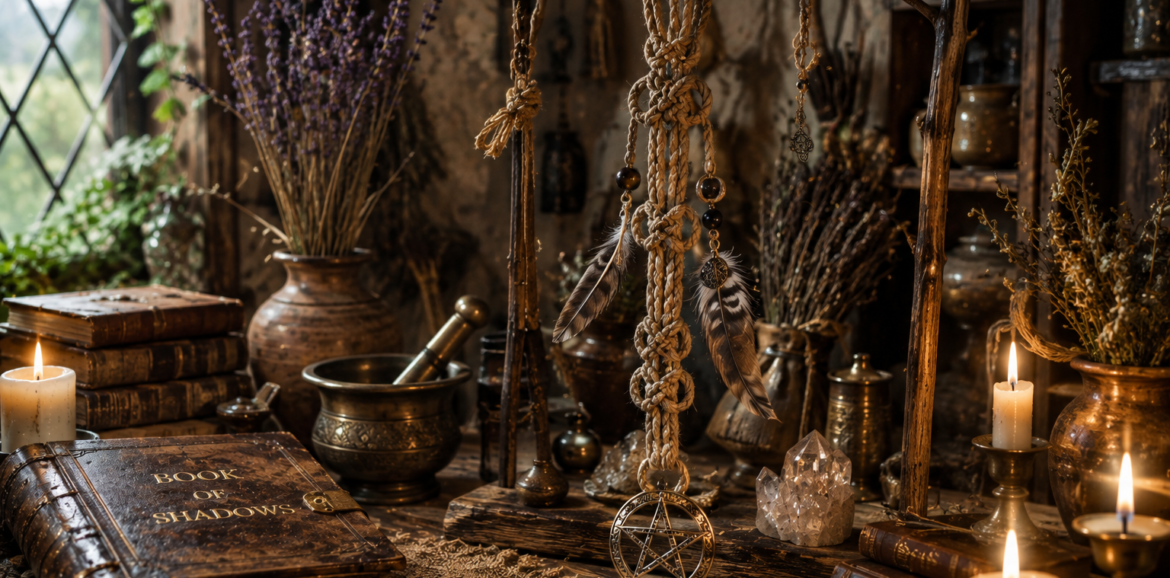
Traditionally described as a cord or braided object containing knots, threads, feathers or other materials, the witch’s ladder has become surrounded by folklore, uncertainty and modern interpretation.
Its history is considerably more complicated than popular culture sometimes suggests.
What is a witch’s ladder?
The term “witch’s ladder” is generally used to describe a knotted or braided cord associated with magical or folkloric practice.
The idea is particularly associated with the nineteenth-century discovery of a curious object in Somerset.
The object was reportedly found in an old house in the late nineteenth century and became known as a witch’s ladder.
It consisted of a cord with numerous knots and was interpreted as evidence of an old magical tradition.
But historians have long debated exactly what the object was and what it represented.
That uncertainty is part of what makes the story so fascinating.
The mysterious Somerset discovery
The famous example was reportedly discovered in the 1870s in a house near Wellington, Somerset.
The story surrounding it quickly attracted attention.
It was said to have been hidden in a roof space, and folklore suggested that the object had been connected with witchcraft.
However, the original object has since disappeared, leaving historians with descriptions and photographs rather than the physical artefact itself.
This creates an unusual historical problem.
We know that the object was reported.
We know that people interpreted it as a witch’s ladder.
But we cannot examine the original object today to settle every question about its purpose.
Was it really an ancient witchcraft object?
That remains uncertain.
Some later writers treated the Somerset object as evidence of a surviving folk-magic tradition.
Others have questioned whether it was actually connected with witchcraft at all.
It may have been an ordinary household object that acquired a magical interpretation later.
This is an important lesson when exploring the history of witchcraft.
Not every object described as magical can be confidently traced back to an ancient magical tradition.
Folklore can change as stories are repeated.
Knots and magic
The association between knots and magic, however, is much older than the witch’s ladder story itself.
Across different cultures, knots have sometimes been given symbolic or magical significance.
The simple act of tying something can become a metaphor for binding, securing, preserving or connecting.
That makes the knot a particularly powerful symbol.
It is perhaps unsurprising that later magical traditions became interested in the idea.
The witch’s ladder in modern witchcraft
The witch’s ladder has experienced something of a revival in modern witchcraft.
Contemporary practitioners may interpret the cord as a symbolic magical object associated with intention, protection, healing, wishes or other personal purposes.
Modern interpretations, however, should not automatically be presented as proof of an unbroken tradition stretching back into ancient Britain.
Modern witchcraft contains many traditions that have been rediscovered, adapted or reinterpreted.
That does not make them meaningless.
It simply means that history and modern practice are not always the same thing.
Why the story survived
Perhaps the greatest attraction of the witch’s ladder is its simplicity.
A mysterious cord hidden away in an old Somerset house makes a wonderfully evocative historical story.
There is something compelling about an ordinary-looking object that may have been connected with beliefs that its owners never explained.
It also reminds us how much of the history of everyday magic has disappeared.
Many people in previous centuries did not write books about their private beliefs.
Their practices may have been passed from one generation to another through family traditions, stories and objects.
When those traditions disappeared, much of the knowledge disappeared with them.
A reminder about magical history
The witch’s ladder sits in an interesting place between history and folklore.
There is a genuine historical story behind the famous Somerset discovery, but some of the claims surrounding it remain uncertain.
That distinction matters.
The history of witchcraft becomes much more interesting when we allow mysteries to remain mysteries instead of automatically turning every unexplained object into proof of an ancient tradition.
A curious piece of witchcraft history
Whether the original Somerset object was genuinely magical, an ordinary household artefact or something that acquired a magical reputation later, the story has endured for generations.
Today, the witch’s ladder has become one of the more unusual symbols associated with traditional and modern witchcraft.
Perhaps its greatest fascination lies not in knowing exactly what it was, but in the questions it leaves behind.
Who made it?
Why was it hidden?
What did its owner believe?
And what other forgotten magical traditions might once have existed quietly in ordinary homes?
Those questions remind us that the history of witchcraft is not confined to famous books and celebrated rituals.
Sometimes, its most intriguing stories begin with a simple object found in an old house.