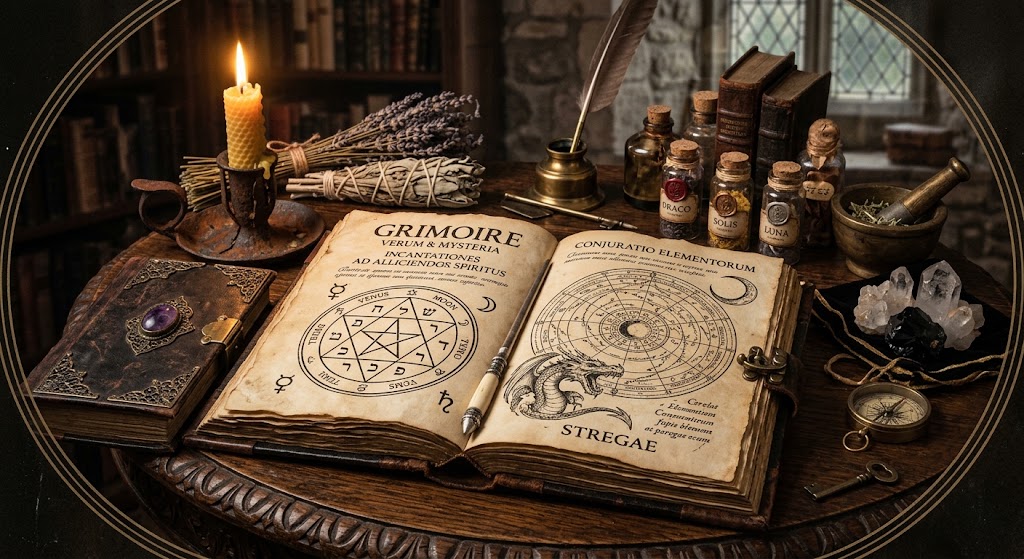
A grimoire is a book associated with magic, ritual, spells, supernatural beings, astrology or other forms of esoteric knowledge.
Thank you for reading this post, don't forget to subscribe!The word itself sounds mysterious, and grimoires have certainly acquired an extraordinary reputation. But behind the legends are fascinating historical documents that reveal how people in different periods recorded, organised and transmitted unusual ideas.
Some were beautifully illustrated manuscripts. Others were practical collections of instructions. Some were attributed to legendary figures even though their true authors remain uncertain.
What does the word grimoire mean?
The word “grimoire” is generally used for a book containing magical or occult knowledge.
It is important, however, not to imagine that every grimoire was identical.
Different books covered different subjects. Some included prayers and religious material alongside magical practices. Others discussed astrology, alchemy, talismans, spirits or ceremonial rituals.
The category is therefore much broader than the modern image of a spell book.
Grimoires were not always ancient
Popular culture often portrays grimoires as incredibly ancient books hidden away in medieval castles.
The reality is more complicated.
Some magical manuscripts are genuinely old, but many famous grimoires appeared in relatively recent periods or were attributed to much earlier figures.
A book might claim to contain the wisdom of an ancient king, prophet or legendary magician even though historians believe it was written centuries later.
These questionable attributions are part of the fascinating history of grimoires.
Why were magical books written?
Writing down knowledge was a way of preserving it.
Before modern printing became widespread, information could be difficult to reproduce accurately. A manuscript therefore represented something valuable.
A grimoire might bring together material that would otherwise exist in scattered traditions.
It could contain diagrams, names, symbols, prayers, instructions, tables or descriptions of rituals.
For someone interested in historical beliefs, these books provide a remarkable glimpse into the ideas of the people who created or copied them.
The connection with astrology
Many grimoires included astrological material.
The movements of the planets and stars were once considered relevant to events on Earth by many practitioners of astrology and magic.
Consequently, a magical manuscript might contain planetary symbols, astrological calculations and information about particular times considered significant.
This illustrates how subjects that we now separate into different categories were historically interconnected.
Magic, astrology, religion and natural philosophy could appear together in the same work.
Grimoires and alchemy
Some magical manuscripts also overlapped with alchemical traditions.
Alchemy was concerned with the transformation of substances and was connected with ideas about purification, hidden properties and the nature of matter.
The boundaries between alchemy, medicine, astrology and magic were not always as sharply drawn in earlier centuries as they are today.
This is one reason historical grimoires can be particularly interesting to anyone studying the history of ideas.
The mysterious reputation of grimoires
Stories about secret magical books have fascinated people for generations.
The idea of a hidden volume containing forbidden knowledge is powerful because books normally represent knowledge that can be passed from one person to another.
A mysterious manuscript therefore becomes almost a character in its own right.
This idea has been used extensively in novels, films, television programmes and games.
The fictional grimoire is often portrayed as dangerous or supernatural, whereas historical grimoires are more complicated documents created by real people within particular cultural settings.
Not every grimoire was a secret masterpiece
It is also worth remembering that historical manuscripts were often copied, altered and passed between owners.
Errors could enter the text.
Material could be added.
Different versions of the same work could develop.
Consequently, there is not necessarily one definitive version of every famous grimoire.
For historians, comparing different manuscripts can be just as interesting as reading the magical material itself.
Grimoires as historical evidence
Whatever one believes about magic, grimoires are valuable as evidence of what people once thought, feared, hoped for and attempted to understand.
They reveal how earlier societies approached questions about destiny, hidden forces, health, morality, the natural world and the unknown.
That makes them important beyond the world of occultism.
They belong to the broader history of human curiosity.
Why are grimoires still fascinating today?
The modern fascination with grimoires probably comes from several things at once.
They are books, but they are books surrounded by secrecy.
They contain symbols that can look unfamiliar.
They often combine subjects that modern readers would normally keep separate.
And some carry centuries of stories about their supposed origins and powers.
Even when approached purely as historical documents, they can be captivating.
A final thought
A grimoire is more than an old book of spells.
It can be a record of changing beliefs, a collection of ritual traditions, a piece of literary history or evidence of the way earlier generations attempted to understand the mysterious.
Some were genuinely old manuscripts. Others were much newer works dressed in ancient authority.
Either way, the history of grimoires opens a fascinating window onto humanity’s enduring desire to understand what lies beyond the ordinary.