Encyclopedia Section:
Separating Myth From Reality
Few subjects connected with the history of religion, witchcraft and the supernatural are more misunderstood than devil worship.
Thank you for reading this post, don't forget to subscribe!The expression immediately creates powerful images: secret ceremonies, forbidden magic and mysterious groups meeting in darkness.
But the historical reality is considerably more complicated.
To understand the subject properly, it is necessary to distinguish between folklore, religious belief, accusations of witchcraft and actual modern movements.
Where Did the Idea of the Devil Come From?
The concept of an evil supernatural adversary developed over a long period within religious traditions.
The figure commonly known as Satan became particularly important within Christian theology, although ideas concerning evil supernatural beings have appeared in many cultures and religious systems.
Over centuries, different writers, theologians and artists gave the figure increasingly elaborate characteristics.
This helped create the familiar image of the Devil found in Western culture today.
Were Witches Really Devil Worshippers?
This is an important historical question.
During periods of European witch persecution, accused witches were sometimes alleged to have entered into agreements with the Devil.
These accusations could form part of legal proceedings and religious campaigns.
However, an accusation is not automatically proof that the accused person actually practised devil worship.
Many people accused of witchcraft denied the charges, and historians today recognise that witch trials were influenced by complex combinations of religion, politics, fear, social conflict and local circumstances.
The Myth of the Satanic Coven
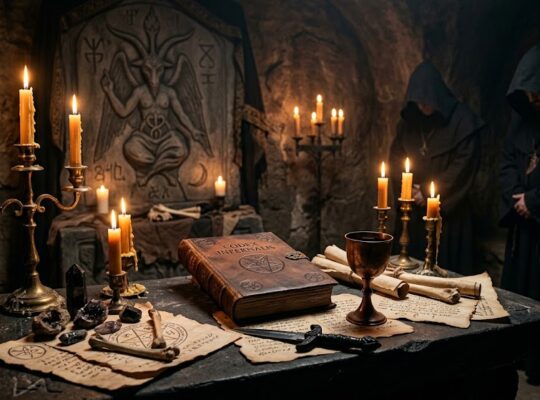
Popular culture has created a particularly dramatic image of secret covens devoted to Satan.
Stories of enormous midnight ceremonies have appeared in literature and later in films and television.
Some of these stories were based more upon fear and imagination than reliable evidence.
The idea of a hidden worldwide network of devil-worshipping witches has consequently become one of the most persistent myths associated with the history of witchcraft.
Modern Satanism Is Not One Single Belief System
Another important distinction is that modern Satanism encompasses different movements and philosophies.
Not every person who uses Satanic symbolism believes in a literal supernatural Devil.
Some modern Satanic organisations are explicitly non-theistic and use Satan as a symbol of individualism, rebellion or personal freedom.
Others have more explicitly religious or supernatural interpretations.
It is therefore inaccurate to assume that everybody described as a Satanist believes the same thing.
What About Sacrifice?
Stories of human sacrifice and animal sacrifice frequently appear in discussions of ancient religion, witchcraft and alleged devil worship.
Sacrifice has existed historically in a number of religious cultures, but practices varied enormously.
It is important not to take a dramatic story from one culture and assume it represents all magical or pagan traditions.
Nor should historical discussion be confused with modern encouragement of harmful acts.
Modern witchcraft is enormously diverse, and many contemporary practitioners strongly reject violence and harm.
Why Do Sacrifice Stories Fascinate People?
Part of the fascination comes from the fact that sacrifice represents something profound.
At its simplest, sacrifice means giving something up in the hope of obtaining a desired spiritual, religious or symbolic outcome.
Historically, the offering might have involved food, possessions, animals or other valued objects.
The meaning depended upon the culture and religious tradition.
Modern popular culture has often concentrated on the most sensational examples.
Devil Worship and Witchcraft Are Not the Same Thing
This distinction is essential.
Witchcraft refers to a wide variety of magical and folk traditions.
Paganism encompasses numerous religious and spiritual traditions, many of which have nothing whatsoever to do with Satan.
Satanism refers to particular modern religious or philosophical movements, some theistic and some non-theistic.
Devil worship is a much narrower expression and is often used loosely in popular discussion.
Combining all of these subjects into one category creates confusion rather than understanding.
Why the Subject Remains Fascinating
Devil worship occupies an unusual position between religion, folklore, history, psychology and popular culture.
It raises questions about how societies define evil, how fear develops and how stories change as they pass from one generation to another.
It also demonstrates why subjects connected with witchcraft need to be examined carefully.
What sounds like a simple story can contain centuries of religious history and cultural misunderstanding.
Looking Beyond the Legend
The real history of the supernatural is often more interesting than the fictional version.
Behind the stories of devils, witches, covens and forbidden ceremonies are real people, real historical events and changing ideas about religion and magic.
Studying those subjects does not require sensationalism.
Indeed, the deeper we look, the more fascinating the history becomes.
The world of witchcraft, magic, Satanic belief, folklore and spiritual traditions is far more complicated — and far more intriguing — than the stories told in popular culture.