Few subjects have accumulated as much fear, mythology and misunderstanding as devil worship.
Thank you for reading this post, don't forget to subscribe!The expression has been used in many different ways throughout history.
Sometimes it has described genuine religious or occult beliefs.
At other times it has simply been an accusation made against people whose beliefs were considered strange, dangerous or heretical.
Understanding the difference is essential.
What Is Devil Worship?
In its simplest sense, devil worship would mean the veneration or worship of a figure understood as the Devil.
However, the meaning becomes much more complicated when examined historically.
Different religions have developed different ideas about Satan, the Devil and other figures associated with evil.
Not all people who study or discuss Satan believe in or worship such a being.
Satan in Religious Tradition
The figure commonly known as Satan has a long and complicated history.
The concept developed through religious traditions over many centuries, and its meaning has changed over time.
In Christianity, Satan is generally associated with opposition to God and evil.
Other religious and cultural traditions have their own interpretations of similar figures.
It is therefore important not to assume that every reference to Satan represents the same belief.
The Historical Accusation
One of the most disturbing aspects of the subject is that accusations of devil worship have sometimes been made against innocent people.
Throughout history, minority religious groups, outsiders and people suspected of witchcraft could be accused of serving the Devil.
Such accusations could have devastating consequences.
A historical accusation is therefore not automatically evidence that devil worship actually occurred.
Witchcraft and Devil Worship Are Not the Same Thing
These terms are often mixed together.
Historically, however, witchcraft and devil worship are not synonymous.
Many forms of witchcraft have had nothing to do with Satan or Christianity.
Witchcraft has included folk practices, healing traditions, divination, magical beliefs and many other forms of spiritual or cultural activity.
Equating every witch with devil worship is therefore historically inaccurate.
Satanism Is Also Not a Single Belief
The word Satanism itself covers different modern movements and philosophies.
Some Satanists are religious and regard Satan as a supernatural being.
Others are non-theistic and use Satan primarily as a symbol of individualism, rebellion, rationalism or personal freedom.
Consequently, the terms Satanism and devil worship should not automatically be treated as interchangeable.
Where Did the Fear Come From?
Fear of devil worship became particularly powerful in societies where religious conformity was considered extremely important.
Anything perceived as opposing established religious authority could be portrayed as evil.
Stories of secret ceremonies, forbidden magic and sinister groups could then grow through rumour.
Over time, some of those stories became part of popular culture.
Devil Worship in Popular Culture
Books, films and television have created countless fictional portrayals of devil worship.
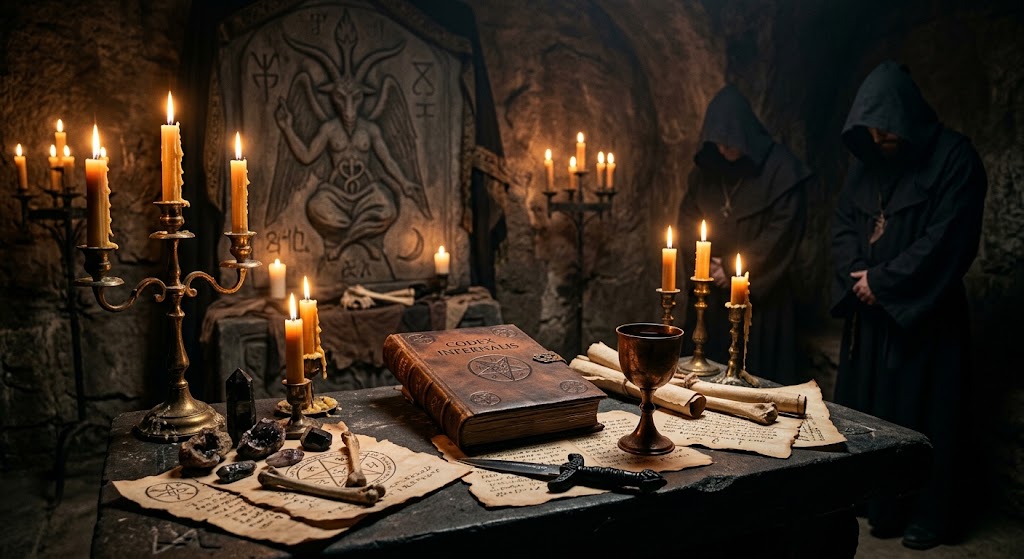
Secret underground ceremonies, mysterious symbols and supernatural powers have become familiar imagery.
These stories can be entertaining, but fiction should not be confused with historical evidence.
Are There Genuine Occult Groups?
There have certainly been occult organisations and individuals who have incorporated Satanic imagery or beliefs into their practices.
But each group needs to be examined individually.
There is no single worldwide organisation controlling everyone who uses Satanic or demonic symbolism.
The subject is considerably more complicated than popular culture often suggests.
The Importance of Historical Evidence
When investigating claims about devil worship, it is particularly important to ask:
Who made the accusation?
What evidence exists?
Was the alleged practice actually witnessed, or merely reported as a rumour?
Was the accusation made during a period of religious or political conflict?
These questions can completely change our understanding of an historical story.
A Subject Filled With Mystery
Devil worship occupies an unusual position between religion, folklore, occultism and popular imagination.
Some people genuinely hold beliefs involving Satanic or demonic figures.
Others reject the supernatural entirely.
And throughout history, many people have simply been accused of beliefs they never held.
That complexity is precisely why the subject belongs in an encyclopedia of the paranormal and unexplained.
The truth is rarely as simple as the frightening stories suggest.
And when we look beyond the myths, we discover something even more fascinating:
the history of devil worship is also a history of fear, belief, accusation, symbolism and the human fascination with the forbidden.