The Mysterious Folklore of Locks, Doors and Hidden Knowledge
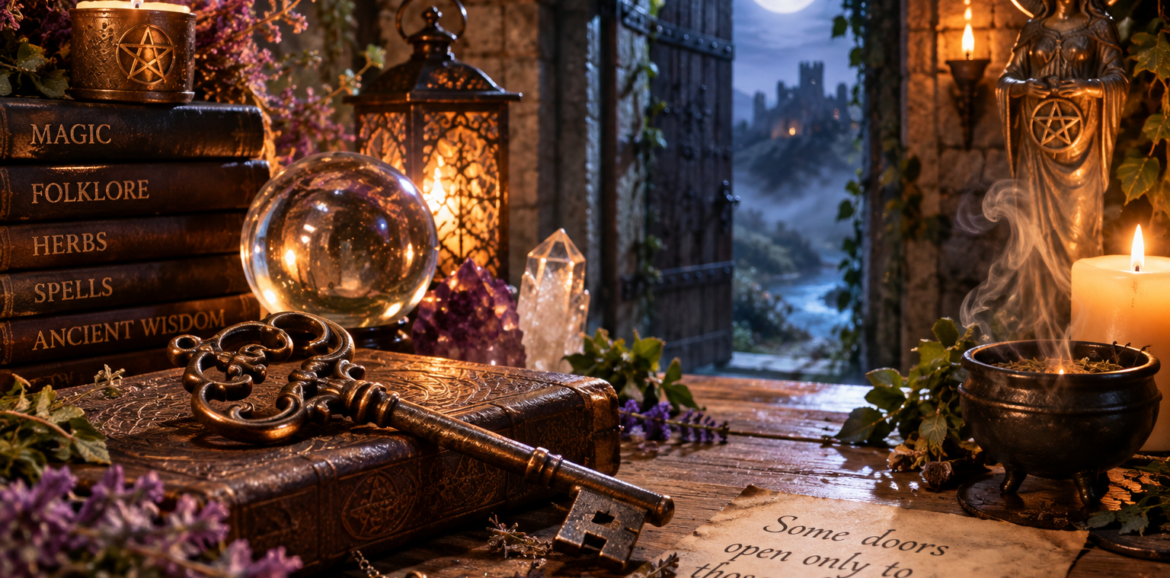
A small old key can be an extraordinarily evocative object.
Thank you for reading this post, don't forget to subscribe!It may open a cottage door, an ancient chest, a forgotten cupboard or perhaps nothing at all because the lock it once belonged to disappeared generations ago.
Yet throughout folklore and magical symbolism, the key has represented something far greater than a piece of metal.
It can symbolise access, secrecy, protection, discovery and the opening or closing of a path.
Why Are Keys So Mysterious?
For much of history, locks protected things that mattered.
A locked door separated the safety of the home from the outside world. A locked chest could protect money, documents or treasured possessions.
The person holding the key therefore possessed something important: the ability to decide what remained closed and what could be opened.
It is easy to understand how such an everyday object acquired powerful symbolic associations.
The Symbolism of Opening and Closing
Witchcraft and magical traditions frequently use physical objects to represent an intention or idea.
A key is particularly interesting because it performs two opposite actions.
It can open, but it can also lock.
Symbolically, opening might represent opportunity, discovery or entering a new stage of life. Closing can represent protection, completion or leaving something behind.
The significance depends upon the tradition and the person interpreting it.
Keys, Doorways and Thresholds
Doorways have fascinated people for centuries.
A threshold is neither entirely inside nor entirely outside. It marks the point where one place ends and another begins.
This has helped doors, gates and entrances acquire an enormous collection of folklore.
A key naturally belongs to that same world of symbolism because it controls passage through the locked entrance.
For somebody interested in witchcraft, that makes the combination of door, lock and key particularly atmospheric.
The Key as a Symbol of Hidden Knowledge
We still use the language of keys metaphorically today.
We speak about finding “the key to the mystery” or discovering “the key to understanding.”
The expression survives because a key represents access to something that was previously unavailable.
Within esoteric and magical traditions, that idea can become especially powerful. Ancient manuscripts, secret teachings and magical knowledge have often been imagined as mysteries available only to people possessing the correct knowledge to unlock them.
The key therefore becomes a natural symbol of discovery.
Old Keys and Magical Imagination
An antique key has a particular fascination because we may no longer know what it opened.
Was it a cottage?
A church door?
A chest?
A private room?
The unanswered question gives the object a history that we can sense but cannot completely recover.
For a modern witch interested in symbolism, folklore and old objects, that mystery can itself be meaningful.
Keys in Modern Witchcraft
Modern witchcraft is extraordinarily varied, and there is no universal rule governing the use of keys.
Some practitioners may place an old key on an altar because of its personal symbolism. Others may associate keys with opportunity, protection, secrets or spiritual discovery.
Another witch may attach no magical importance to them whatsoever.
That diversity is important. Witchcraft has never been one identical practice followed by everybody.
The Magic of an Ordinary Object
Perhaps this is what makes keys such a beautiful subject.
They demonstrate how an object does not have to be expensive or spectacular to become symbolically powerful.
A weathered iron key resting in the palm of your hand may once have protected someone’s home or possessions.
Centuries later, it can still provoke the same intriguing question:
What might this key unlock?