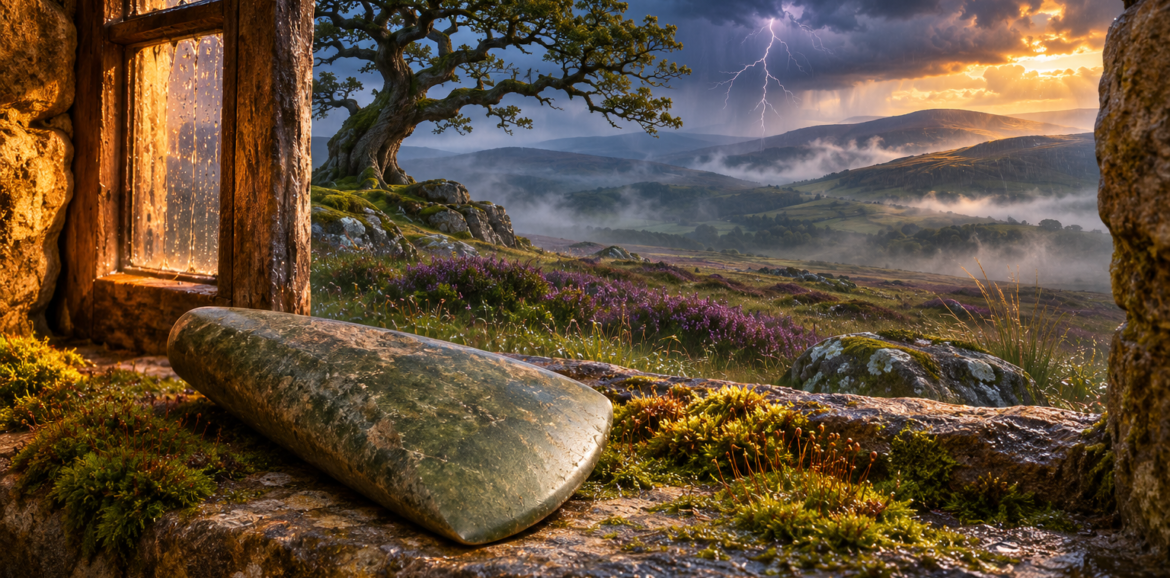
Thunderstones: When Ancient Tools Were Mistaken for Fallen Lightning
Thunderstones are prehistoric stone objects that later generations associated with lightning and protective folklore. Their story reveals how ancient tools could acquire a second life as treasured charms—and offers a fascinating subject for anyone interested in witchcraft and protection spells.
Thank you for reading this post, don't forget to subscribe!Imagine turning over the soil and finding a smooth stone with a carefully shaped edge. You recognise that it is unusual, but have no explanation for who made it or when.
Now imagine encountering it centuries before the story of prehistoric stone tools was widely understood. Could something so strange have fallen from the sky?
That question takes us into the remarkable folklore of thunderstones.
What are thunderstones?
The name thunderstone was applied to ancient stone objects that later generations understood through supernatural belief. An implement made for one purpose could acquire another identity long after its original maker had been forgotten.
Research by archaeologist Tomasz Kurasiński examines prehistoric stone objects placed in roofs, walls, chimneys and thresholds during the medieval and modern periods. He interprets these repeated placements as evidence of protective uses across different European regions.
These objects therefore belong to two histories: the history of their manufacture and the later history of the beliefs attached to them. journals.iaepan.pl
A family treasure in Jersey
The Pitt Rivers Museum records a revealing account from collector Edward Lovett. In Jersey, he encountered a polished stone axe in a labourer’s cottage. Its owner regarded it as a thunderbolt that would protect his family and repeatedly refused offers to buy it.
For the collector, it was an interesting stone implement. For its owner, it carried a deeply personal promise of safety.
The account records a belief, rather than demonstrating a protective power. Yet it helps explain why an apparently modest object could be valued beyond its price. web.prm.ox.ac.uk
Thunderstone folklore and the meaning of old objects
There is something extraordinary about an object outliving the knowledge of its own creation. The hands that shaped it disappear from memory; later hands pick it up and give it a new story.
We do something similar whenever we inherit a possession whose full history we cannot recover. We examine its marks, ask questions and imagine the journeys it might have made.
Thunderstones invite us to look at the distance between an object and its interpretation. A stone can be entirely real while the explanation attached to it changes.
For anyone drawn to folklore and spiritual history, that is a compelling mystery: how many things around us have already lived more than one life in the human imagination?
Witchcraft, protective charms and spells
Thunderstone folklore offers a useful starting point for exploring the meaning of protection in witchcraft. The wish to keep a home or family safe also helps explain the appeal of protective charms and protection spells. These are related themes, though we should not assume that every historical owner of a thunderstone practised witchcraft.
At David Charles Psychic and Stardust Spells, I explore white witchcraft and the symbolism of spells alongside my work as an international psychic medium. For readers curious about these subjects, thunderstones offer a reminder to ask where a tradition comes from, what its symbols mean and which claims the evidence supports.
David Charles — International Psychic Medium and Master of Witchcraft